The man who is sound in the faith, and who understands the higher and sublimer doctrines of divine revelation, will have wells of consolation which the less instructed cannot know. (Vol. 9: Spurgeon’s Sermons, “The Root of the Matter”)
Christianity
Christianity,Friday, March 19, 2010
My Mother First Taught Me and Then My Wife
Yes, today is my birthday. But I don’t get to have it all to myself because I was a birthday gift to my mother. I was born on my mother’s birthday! Happy Birthday Mom! 
So, from an early age, she taught me how to share my birthday. It’s sorta strange singing the birthday song to each other and I’m always stuck somewhere between wanted the day to be all for me and all for her. Nevertheless, I never remember a birthday that I felt robbed of the limelight. Every birthday has been a more special day than your average day. Perhaps all the birthday gifts have something to do with it. 
So how did Jenn teach me to share my birthday? Well, she found a very special man in the history of Christianity who has deepened my appreciation for this day. John Piper posted this article on his Design God blog. Jenn found it and passed it on to me. Now I’ll reproduce it here.
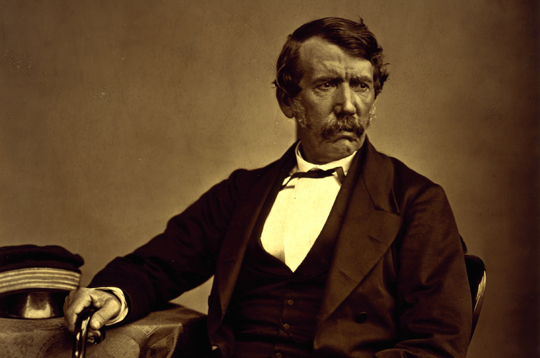
David Livingstone, written by John Piper
“Today is David Livingstone’s birthday. He was born March 19, 1813. He gave his life to serve Christ in the exploration of Africa for the sake of the access of the gospel.
“On December 4, 1857, he spoke the sentence that has made the greatest impact on me. It is one of the clearest applications I have seen of Jesus’ words in Mark 10:29-30. Jesus said,
“Truly, I say to you, there is no one who has left house or brothers or sisters or mother or father or children or lands, for my sake and for the gospel, who will not receive a hundredfold now in this time, houses and brothers and sisters and mothers and children and lands, with persecutions, and in the age to come eternal life.
“Here is what Livingstone said to the Cambridge students about his “leaving” the benefits of England:
“For my own part, I have never ceased to rejoice that God has appointed me to such an office. People talk of the sacrifice I have made in spending so much of my life in Africa. . . . Is that a sacrifice which brings its own blest reward in healthful activity, the consciousness of doing good, peace of mind, and a bright hope of a glorious destiny hereafter? Away with the word in such a view, and with such a thought! It is emphatically no sacrifice. Say rather it is a privilege. Anxiety, sickness, suffering, or danger, now and then, with a foregoing of the common conveniences and charities of this life, may make us pause, and cause the spirit to waver, and the soul to sink; but let this only be for a moment. All these are nothing when compared with the glory which shall be revealed in and for us. I never made a sacrifice.
(Cited in Samuel Zwemer, “The Glory of the Impossible” in Perspectives on the World Christian Movement, Ralph Winter and Stephen Hawthorne, eds. [Pasadena: William Carey Library, 1981], p. 259. Emphasis added.)”
Family,Sunday, January 24, 2010
The Simple Faith of a 2 Year Old
At the end of our family worship we ask each of our children to prayer for something. We asked Claire if she would prayer for the children in Haiti. We explained that their houses were crushed and some of them don’t have any mommy or daddy.
Claire said, “I share my daddy; I share my mommy” (She’s only two, so the English is a bit broken).
Jenn and I looked at each other and were moved by her compassionate response. We asked her a second time to confirm that she would really want to share us: she did. What a simple solution, at least form her perspective!
In her prayer she continued to voice her desire to share her daddy with the children of Haiti. I must admit I was a little choked up at that point. We all finished our prayers and Jenn asked, “so, will we be adopting a child from Haiti?”
I said, “Who knows, I guess we’ll see.”
Well, that’s quite a prayer. It’s easy to discount her little prayer as just the naivety of a 2 year old who’s prayer is straight from the heart. She really wasn’t thinking about the difficulty of the thing she was asking. At the same time, the Bible calls Christians to do this very thing.
“Religion that is pure and undefiled before God, the Father, is this: to visit orphans and widows in their affliction, and to keep oneself unstained from the world.” (Jas 1:27)
Perhaps this is one of the qualities of a child that makes them the greatest in the kingdom of heaven.
“Truly, I say to you, unless you turn and become like children, you will never enter the kingdom of heaven. Whoever humbles himself like this child is the greatest in the kingdom of heaven” (Matt 18:3-4).
Christianity,Wednesday, December 30, 2009
A Gleaning from Spurgeon’s Sermon: “The Root of the Matter”
The man who is sound in the faith, and who understands the higher and sublimer doctrines of divine revelation, will have wells of consolation which the less instructed cannot know. (Vol. 9: Spurgeon’s Sermons, “The Root of the Matter”)
an important doctrine for providing comforting assurance
Spurgeon goes onto to point to the doctrine of election as not essential, but is one such example of a doctrine which provides “wells of consolation” —I heartily agree. Yes, I’m a Calvinist like Spurgeon; I certainly don’t think it’s a test of faith, but I find it an important doctrine for providing comforting assurance for the believer and correcting errors in regards to the sovereignty and holiness of God.
Studying the “higher and sumblimer” doctrines are challenging, but I’ve found the reward to be so great that I have developed a bit of an addiction to digging deeper and discovering these treasures. Sometimes people may think that I’m just trying to be right all the time, or act like a know-it-all, but the reality is, I find “wells of consolation” and wish to share it with others.
Christianity,Friday, December 18, 2009
The Manhattan Declaration attempts to join Christians together against abortion, in protection of traditional marriage, and for religious freedoms. But in reading the document I realized that I cannot sign it. The entire document has language that is troubling, but the following paragraph convinced me that I cannot sign it
We are Christians who have joined together across historic lines of ecclesiastic differences to affirm our right—and, more importantly, to embrace our obligation—to speak and act in defense of these truths. We pledge to each other, and to our fellow believers, that no power on earth, be it cultural or political, will intimidate us into silence or acquiescence. It is our duty to proclaim the Gospel of our Lord and Savior Jesus Christ in its fullness, both in season and out of season. May God help us not to fail in that duty.
First, I don’t agree that everyone who signs this document is a Christian and some people teach things that I cannot approve of. With such people, I cannot agree that we are both proclaiming the same Gospel. For example, I took a look at the leaders who signed the document and can see that there are Catholics leaders signing this document. The Catholic church has problematic doctrine that adds the tradition of men and the sayings of popes to the Gospel. Protestant churches largely believe justification by faith in Christ alone is at the heart of the Gospel; while the Catholic church teaches that it’s not justification by faith alone, but there are sacraments and other traditions by which the church makes it possible for someone to reach heaven. I realize there are a variety of Catholics, who, despite the teachings of the Catholic church possess a genuine faith in Jesus Christ as their Savior; but I cannot sign a document proclaiming that I am in unity with the Catholic church’s gospel when I know that we are not.
Also, consider that there are false teachers in many denominations, Catholic and more, who lead people away from the truth and teach dangerous lies; how can I, in good conscience, sign this document and have my name permanently side-by-side with such people? It would be foolish for me to sign it.
Second, the declaration confuses the Gospel and is more likely to communicate a false understanding of the Gospel. Today we have the prosperity gospel, the social gospel, the universalism gospel. I can recall my own personal conversations with a Catholic teacher who clearly taught a false gospel. I do not agree that I stand side-by-side with the other signers proclaiming the Gospel of our Lord and Savior Jesus Christ.
The declaration also makes no mention of the contents of the Gospel. It briefly mentions it, immediately after a section talking about the social issues. This makes the Gospel seem more to do with social issues than with the Gospel of Jesus that was taught in the Bible. The Gospel in the Bible teaches that all have sinned and fallen short and are in need, not of social justice, but of forgiveness of sins. And the good news of the Gospel is that Jesus Christ has accomplished the forgiveness of sins through his death on the cross and that this forgiveness is a free gift from God for all who repent of their sins and believe in Christ as Lord and Saviour.
This declaration would be much better if it stuck with combating the social evils. I desire remedies to these social evils, but it is more important to take seriously the Gospel of our Lord Jesus Christ and not confuse it by providing opportunities for it to be attached to false gospels. America is already confused enough about the Good News. Many professed Christians cannot give a correct answer to this essential truth of the Christian faith. It is of prominent importance to stand firm and proclaim the Gospel with clarity and without mixture, synthesis, or confusion.
John MacArthur also has an excellent response.
Christianity,Tuesday, December 15, 2009
I appreciate Sproul’s desire to stand firm on for the faith of the Gospel and his decision to say no to the Manhattan Declaration. I also appreciate Albert Mohler’s desire to recognize the importance of the Manhattan Declaration and the specific purpose it serves in fighting social evils. He said yes to the Manhattan Declaration, signed it and wrote about his decision. Two people I admire made completely opposite decisions and they both have excellent reasons for the decisions they made.
So was Sproul too critical about the language in the Manhattan Declaration? Was his concern for the compromise of the Gospel faith unwarranted? Was Albert Mohler too relaxed in his decision to sign this declaration? Did he fail to consider the compromises that were being made?
I guess it’s time for me to study this declaration from myself! If you haven’t please read the Manhattan Declaration and let me know what you decide and why. I’m planning to study it more carefully and decide for myself too.
